
The cost-of-Miliband crisis is driving up energy bills
Commenting on the latest rise in the Ofgem price cap between 01 October 2025 and 31 December 2025, Maurice Cousins, Campaign Director at Net Zero Watch, said:
Today’s Ofgem price cap rise is devastating for families already struggling with the cost of living. But the real punch in the gut is that electricity costs the same to make today – in real terms – as it did in 2015, yet the average household is paying nearly £300 more. That’s not an energy crisis. It’s a cost-of-Miliband crisis. Ofgem’s own data shows this rise is being driven by policy costs: green levies, carbon charges and Net Zero subsidies. Ed Miliband should stop spreading Net Zero disinformation and start owning the real-world consequences of the agenda he’s pushing.
ENDS
Notes to editor
Net Zero Watch’s statement refers to the latest Ofgem energy price cap, which will rise to £1,755 from 1 October 2025 – an increase of £35 per year for the average dual-fuel household.
According to Ofgem’s published cost breakdown, the direct cost of generating electricity today (wholesale costs less carbon taxes) is the same as it was in 2015.
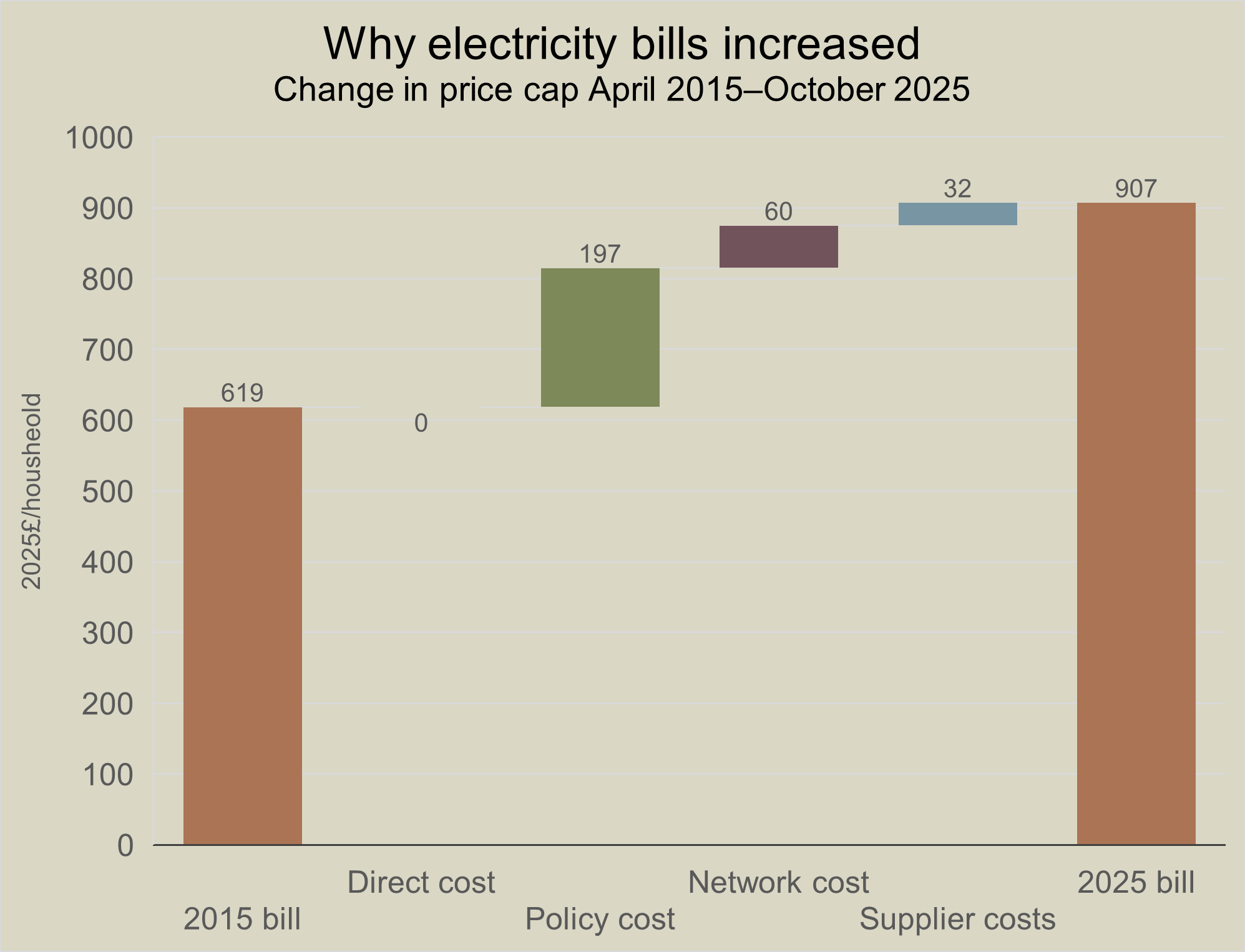
Today, average household bills are £288 higher in real terms, from £619 in 2015 to £907 in 2025. This increase is not driven by energy market fundamentals, but mostly by policy costs – including green levies, carbon pricing, and subsidy schemes associated with Net Zero – and network costs, which are also being driven upwards by Mr Miliband’s policies.
The attached chart (see below) illustrates the breakdown of the increase in the electricity price cap between April 2015 and October 2025, showing that:
Direct generation costs have remained flat
Policy costs have added £197 per household
Network costs have added £60
Supplier costs have added £32
Source: Ofgem data