
Regime change for Arctic sea ice
The decline in Arctic sea-ice has become a poster child for climate change. Who can forget that Al Gore won a Nobel Peace Prize in 2007 for, among other failed climate predictions, saying that the Arctic sea-ice would vanish in the following 5–7 years. It didn’t, and in fact, as re-emphasised in a new research paper, it stabilised.
Stern (2025), writing in Geophysical Research Letters, says that this stabilisation amounts to a regime shift in the behaviour of Arctic ice.
Since satellite observations began in 1979 until 2007 there was an approximately linear decline in September sea-ice extent. In September 2007 it had the largest year-on-year decline in the satellite data record. But 2007 marked a change.
Since then, there have been yearly fluctuations, but no long-term decline. When this was pointed out by so-called sceptics as some kind of ice-pause, the reaction from climate alarmists was, well, predictable. But the sceptics were proved right, as they were with the global temperature hiatus.
The ice sheet has changed. In 2007 it started a transition from a thicker and more deformed ice cover to a thinner and more uniform cover. Fig 1 shows two ways of looking at the data, (a) shows a linear downward trend over all the data, a technique beloved by alarmists. But according to Harry Stern of the Polar Ice Center of the University of Washington (b) is a better way of looking at it.
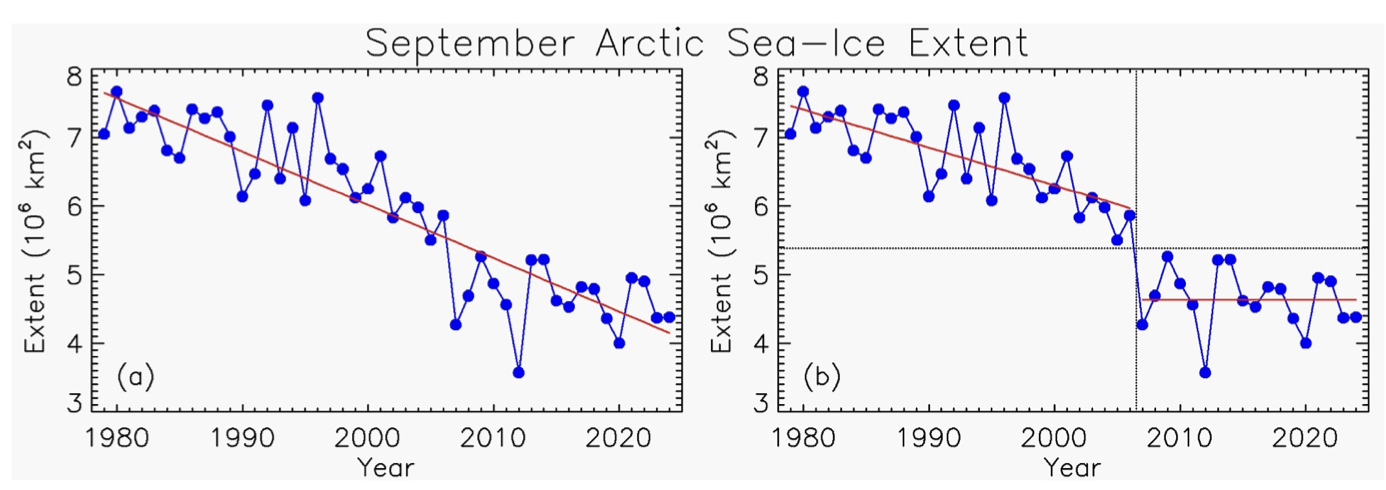
Continual decline or regime change?
Stern says that, whatever the reason for the regime change, Arctic sea-ice is expected to decrease in the future in response to global warming. He says that climate models suggest that it is likely the Arctic will be ice-free before 2050. Such statements are included in papers in the field to ensure publication of inconvenient data.
A longer “pause?”
Should anyone get the wrong impression, the campaigning website CarbonBrief leaps to the rescue, with a guest article by Mark England of the University of California Irvine.
He points out that the Arctic sea-ice has halved since satellite records began in 2007. He goes on to say that since the late 2000s the pace of ice-loss has ‘slowed markedly, with no statistically significant decline for about 20 years’. I think this must be a mistake. Ice extent decline has not ‘slowed markedly’, it has stopped.
He, and colleagues, also have a paper in Geophysical Research Letters that explores the ‘reasons for the recent slowdown’. To make the point again, it’s not a ‘recent slowdown’, it’s a recent cessation. To see what happens next, he turns to climate models.
Their findings show that the ice-pause is a natural fluctuation of the climate system. Natural climatic variability, he says, also ‘played a part’ in the previous ice-loss. They say it is possible that these natural fluctuations might mean that the ice-pause continues for another ten years.
So there you have it. We start observing the Arctic ice via satellite in 1979. For 28 years it declines in extent. Then we can have 30 years of no change, which is just a temporary interruption, in its long-term decline!
The problem with this is that climate models aren’t data. Climate models are known to have severe deficiencies, and running a climate model many times slightly altered each time is not a series of ‘experiments’.
The CarbonBrief parting shot is a warning. ‘While the current slowdown might persist for some years to come, when sea ice loss resumes, it could do so with renewed intensity.’