
Russia and China will read Miliband’s energy policy as weakness
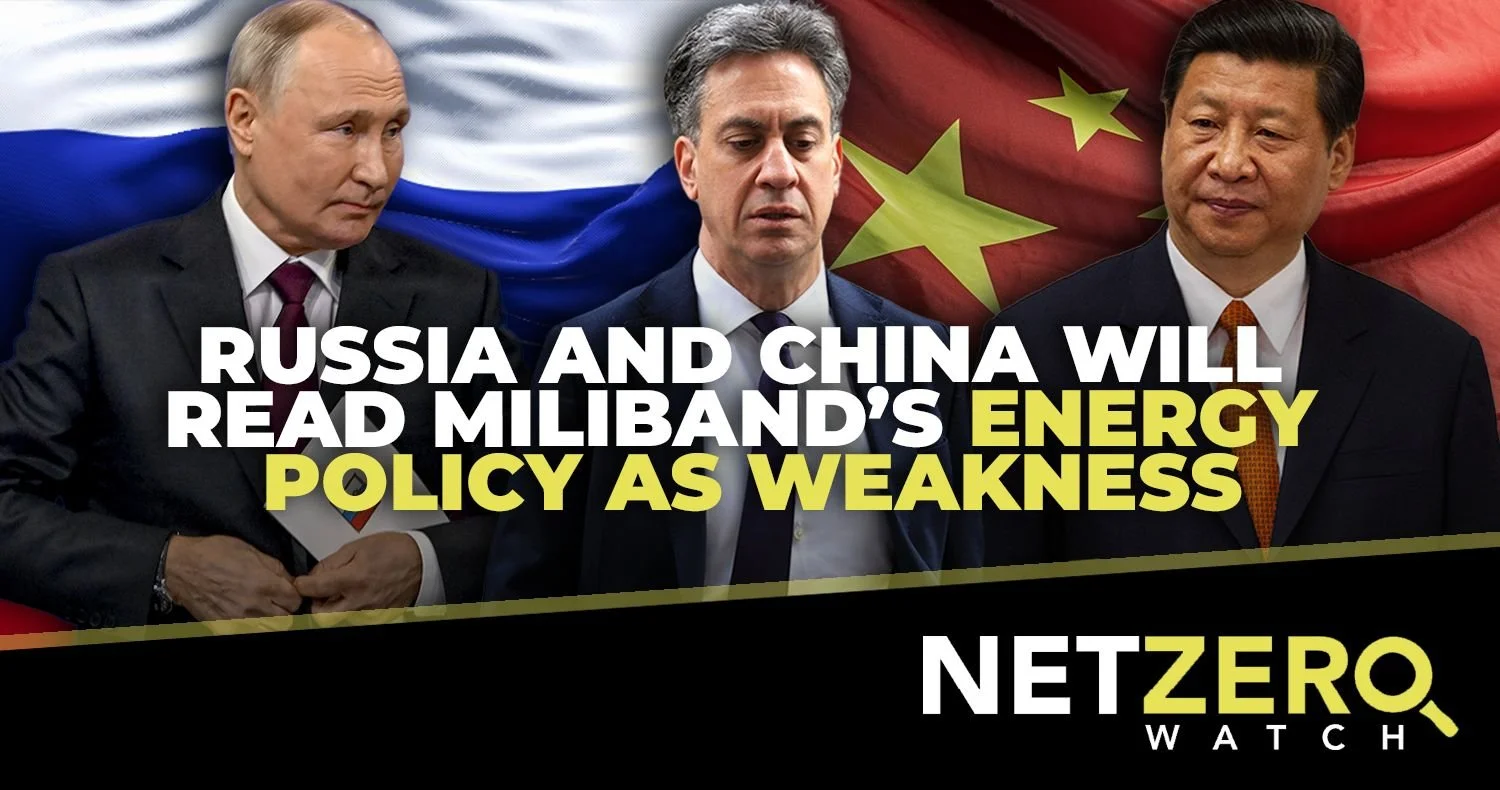
Commenting on today’s (05 March 2026) statement on energy markets to Parliament by Energy Secretary Ed Miliband, Maurice Cousins, Campaign Director at Net Zero Watch, said:
The Government’s response to the turmoil in global energy markets is deeply concerning. At a moment when conflict in the Middle East is threatening oil and gas supplies, when a major war continues in Ukraine, and when serious espionage allegations involving China including individuals with connections to the Labour Party are dominating the headlines, ministers should be thinking far more clearly about the foundations of national power.
Energy security is national security.
British policymakers need to understand that, as in the 1930s, the West today is in an existential struggle with autocracies that are opposed to our values.
Adversaries such as Russia and China do not judge Western countries only by their armed forces or headline defence spending pledges. They study the deeper trajectory of our economies: our industrial capacity, our energy systems and our ability to sustain production in war. When they see a major NATO power like Britain deliberately shrinking its domestic oil and gas sector and driving the decline of energy intensive industries that underpin defence manufacturing and armed forces, they draw conclusions about the wider alliance’s capacity to endure, and our resolve.
That is why energy realism matters. Britain needs secure, abundant and reliable energy. That means recognising the continuing strategic importance of domestic oil and gas, maintaining domestic production and preserving the industrial capacity required to sustain ourselves in a dangerous world.
Instead, the Government is doubling down on naive peacetime policies that weaken our hard power foundations just as the world becomes more dangerous. That is not acting in the national interest. In the current geopolitical climate it amounts to playing with fire. The Prime Minister talks about learning the lessons of the 1930s, but his government’s energy policy is the modern equivalent of disarmament.
What makes this even more cynical is the way Ed Miliband is exploiting the situation. He clearly does not want to let a “good crisis go to waste”. International events are being used to justify policies that will lock Britain into permanently expensive energy, accelerate the destruction of what remains of our industrial economy and weaken our national security.
His claims about energy prices do not stand up to scrutiny. While events in the Middle East are clearly serious, there has so far been little measurable impact on UK energy prices. Gas prices are broadly where they were twelve months ago, and wholesale electricity prices were higher at several points earlier this year, including January.
If this course continues, the only people celebrating will be in Moscow and Beijing.
ENDS